
Bayesian principal stratification (PStrata)

Follow the analysis.
Select a node to explore the method
Specify the principal stratification model
Data preparation — shapes the raw inputs into what the estimator expects.
PStrataModel() declares the strata from the (Z, D) pattern - never-takers '00', compliers '01', always-takers '11' - the outcome family, priors, and which strata obey the exclusion restriction.
# Install:  install.packages("PStrata")
library(PStrata)

model <- PStrataModel(
  S.formula = Z + D ~ 1,
  Y.formula = Y ~ 1,
  Y.family  = gaussian(link = "identity"),
  strata    = c(n = "00", c = "01", a = "11"),
  ER        = c("n", "a"),
  prior_intercept = prior_normal(0, 1),
  prior_sigma     = prior_inv_gamma(1)
)
summary(model)

Before using this step, make its assumptions and its output explicit. A useful peer note explains what you would check, what could go wrong, or what would change your interpretation.
Questions to explore- Which assumption matters most here, and what evidence could challenge it?
- What would you check before passing this output to the next step?
Choose a question to start your comment.
Peer discussion
- Bring your experience, a question, or a different perspective.
Log in to comment on this step.
Fit the model with MCMC
The core estimate — where the causal quantity itself is computed.
fit() compiles the model to Stan and samples the posterior over stratum membership probabilities and outcome parameters across multiple chains.
ps_fit <- fit(model, data = sim_data_normal,
              chains = 4, warmup = 500, iter = 1000)
ps_fit
diagnostics(ps_fit)
Before using this step, make its assumptions and its output explicit. A useful peer note explains what you would check, what could go wrong, or what would change your interpretation.
Questions to explore- Which assumption matters most here, and what evidence could challenge it?
- What would you check before passing this output to the next step?
Choose a question to start your comment.
Peer discussion
- Bring your experience, a question, or a different perspective.
Log in to comment on this step.
Estimate stratum-specific potential outcomes
Uncertainty quantification — standard errors, intervals, and aggregation.
estimate() summarizes the posterior mean potential outcomes E[Y(z)] within each principal stratum as a tidy data frame.
est <- estimate(ps_fit)
summary(est, "data.frame")
plot(est)
Before using this step, make its assumptions and its output explicit. A useful peer note explains what you would check, what could go wrong, or what would change your interpretation.
Questions to explore- Which assumption matters most here, and what evidence could challenge it?
- What would you check before passing this output to the next step?
Choose a question to start your comment.
Peer discussion
- Bring your experience, a question, or a different perspective.
Log in to comment on this step.
Contrast treatment effects within strata
Uncertainty quantification — standard errors, intervals, and aggregation.
contrast() with Z=TRUE forms the within-stratum causal effect Y(1)-Y(0) - notably the complier average causal effect - with full posterior summaries.
ctr <- contrast(ps_fit, Z = TRUE)
summary(ctr, "data.frame")
plot(ctr)
Before using this step, make its assumptions and its output explicit. A useful peer note explains what you would check, what could go wrong, or what would change your interpretation.
Questions to explore- Which assumption matters most here, and what evidence could challenge it?
- What would you check before passing this output to the next step?
Choose a question to start your comment.
Peer discussion
- Bring your experience, a question, or a different perspective.
Log in to comment on this step.
Inputs & data
One row per unit: treatment Z, a post-treatment intermediate D, outcome Y, and any covariates.
Show data format & exampleHide example
| Z | D | Y |
|---|---|---|
| 1 | 1 | 2.31 |
| 0 | 0 | -0.4 |
| 1 | 0 | 0.88 |
| 0 | 0 | 1.05 |
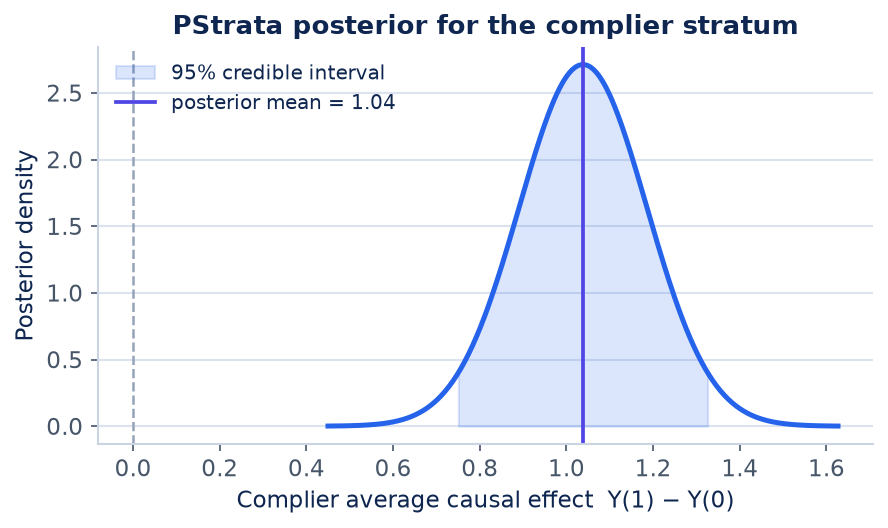
Result figure rendered by StatsOtter from the package's documented example — unofficial community showcase; all credit to the original authors.
The estimate
\tau_g=\mathbb E\big[Y(1)-Y(0)\,\big|\,S=g\big],\qquad S=\big(D(0),\,D(1)\big)
⚠️ Unofficial community showcase of PStrata (docs). Not affiliated with the authors — all credit to Fan Li & coauthors; this summarizes public documentation.
What it does. PStrata estimates principal causal effects — effects defined within latent principal strata such as compliers, always-takers and never-takers — when an intermediate (post-treatment) variable confounds the treatment-outcome relationship. It handles continuous, binary, count, and time-to-event outcomes (Liu & Li, 2023).
How it works. Units are modeled as a finite mixture over principal strata defined by joint potential values of the intermediate variable. A Bayesian model (compiled to Stan) jointly estimates stratum membership probabilities and outcome models within each stratum via MCMC. The workflow is PStrataModel() to specify strata, exclusion-restriction (ER) and monotonicity assumptions and priors; fit() to run MCMC; then estimate() and contrast() for stratum-specific potential outcomes and effects. Users can toggle assumptions (e.g. drop ER) to probe sensitivity.
Assumptions. SUTVA, ignorable treatment assignment, plus user-chosen structural assumptions (monotonicity, exclusion restriction) and outcome-model/prior specification; identification is driven by the mixture model.
What you get — Posterior stratum membership probabilities and stratum-specific causal contrasts (e.g. complier/LATE effect) with credible intervals.
Example output
# Posterior summary of stratum effects (contrast Z=1 vs Z=0)

  stratum    mean     sd    2.5%   median   97.5%  Rhat
1       n  0.0000  0.000   0.000   0.0000  0.0000  1.00
2       c  1.0382  0.1471   0.751   1.0376  1.3271  1.00
3       a  0.0000  0.000   0.000   0.0000  0.0000  1.00

# Stratum proportions
  stratum    mean     sd    2.5%   97.5%
1       n  0.3013  0.0205  0.262   0.342
2       c  0.4021  0.0231  0.357   0.448
3       a  0.2966  0.0198  0.259   0.336
Discuss the workflow (0)
Log in to join the discussion.