

Follow the analysis.
Select a node to explore the method
Load ei and prepare the 2x2 margins
Data preparation — shapes the raw inputs into what the estimator expects.
Load the package and the matproii data, then specify the formula relating the row margin x to the column margin t.
# Install:  install.packages("ei")
library(ei)
data(matproii)
form <- t ~ x

Before using this step, make its assumptions and its output explicit. A useful peer note explains what you would check, what could go wrong, or what would change your interpretation.
Questions to explore- Which assumption matters most here, and what evidence could challenge it?
- What would you check before passing this output to the next step?
Choose a question to start your comment.
Peer discussion
- Bring your experience, a question, or a different perspective.
Log in to comment on this step.
Fit the ecological inference model
The core estimate — where the causal quantity itself is computed.
Estimate the 2x2 EI model, supplying the precinct totals so counts can be recovered.
dbuf <- ei(formula = form, total = "n", data = matproii)
Before using this step, make its assumptions and its output explicit. A useful peer note explains what you would check, what could go wrong, or what would change your interpretation.
Questions to explore- Which assumption matters most here, and what evidence could challenge it?
- What would you check before passing this output to the next step?
Choose a question to start your comment.
Peer discussion
- Bring your experience, a question, or a different perspective.
Log in to comment on this step.
Summarize aggregate estimates
Uncertainty quantification — standard errors, intervals, and aggregation.
Print the district-level aggregate Betab and Betaw estimates with their standard deviations and bounds.
summary(dbuf)
Before using this step, make its assumptions and its output explicit. A useful peer note explains what you would check, what could go wrong, or what would change your interpretation.
Questions to explore- Which assumption matters most here, and what evidence could challenge it?
- What would you check before passing this output to the next step?
Choose a question to start your comment.
Peer discussion
- Bring your experience, a question, or a different perspective.
Log in to comment on this step.
Read out precinct-level betas
Reporting — turn the numbers into a figure or table a reader can act on.
Use eiread() to extract the precinct-specific point estimates of betab and betaw for mapping or further analysis.
betab <- eiread(dbuf, "betab")
betaw <- eiread(dbuf, "betaw")
head(cbind(betab, betaw))
Before using this step, make its assumptions and its output explicit. A useful peer note explains what you would check, what could go wrong, or what would change your interpretation.
Questions to explore- Which assumption matters most here, and what evidence could challenge it?
- What would you check before passing this output to the next step?
Choose a question to start your comment.
Peer discussion
- Bring your experience, a question, or a different perspective.
Log in to comment on this step.
Inputs & data
Aggregate unit-level data: for each district, two observed margins (e.g. fraction black and turnout) and the population size.
Show data format & exampleHide example
| precinct | x_black | t_turnout | n |
|---|---|---|---|
| 1 | 0.20 | 0.55 | 800 |
| 2 | 0.65 | 0.48 | 1200 |
| 3 | 0.10 | 0.61 | 950 |
| 4 | 0.40 | 0.52 | 700 |
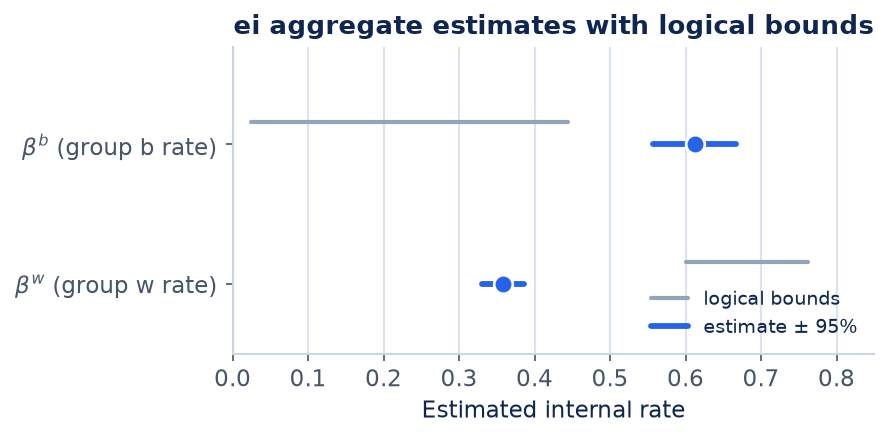
Result figure rendered by StatsOtter from the package's documented example — unofficial community showcase; all credit to the original authors.
The estimate
T_i=\beta_i^{b}\,X_i+\beta_i^{w}\,(1-X_i),\qquad 0\le\beta_i^{b},\beta_i^{w}\le 1
⚠️ Unofficial community showcase of ei (docs). Not affiliated with the authors — all credit to Gary King & coauthors; this summarizes public documentation.
What it does: The ei package implements Gary King's solution to the ecological inference problem—estimating unobserved individual-level relationships (e.g. how subgroups voted) using only aggregate data such as precinct or district marginals. How it works: For 2x2 tables it combines the deterministic accounting identity (which bounds each unit's unknowns given its margins) with a statistical model: a truncated bivariate normal distribution over the unit-level parameters, estimated by maximum likelihood and simulation. This yields district-level and aggregate point estimates with uncertainty, while respecting the logical bounds each precinct imposes. Assumptions: The model's distributional form (truncated bivariate normal), no spatial autocorrelation beyond what's modeled, and absence of certain aggregation bias; diagnostics and extended models address some violations. Output: estimated internal cell quantities (e.g. fraction of each group voting), with bounds and credible intervals, at both unit and aggregate levels.
What you get — Estimated internal cell quantities (e.g. group-specific turnout) with bounds, at unit and aggregate levels.
Example output
Maximum likelihood results in scale of estimation (and se's)
           [,1]   [,2]
Zb        0.314  0.184
Zw        0.733  0.114

Aggregate Bounds
         betab betaw
lower    0.025 0.601
upper    0.444 0.762

Estimates of Aggregate Quantities of Interest
        mean     sd
Bb     0.612  0.028
Bw     0.358  0.014
Discuss the workflow (0)
Log in to join the discussion.