
IV with heterogeneous effects: the LATE (ivreg)

Follow the analysis.
Select a node to explore the method
Load data and specify the IV formula
Data preparation — shapes the raw inputs into what the estimator expects.
Use the classic Kmenta market data and write the two-part formula y ~ regressors | instruments separating endogenous and exogenous terms.
# Install:  install.packages("ivreg")
library("ivreg")
data("Kmenta", package = "ivreg")
# Q ~ P + D, with P endogenous; instruments are D, F, A
f <- Q ~ P + D | D + F + A

Before using this step, make its assumptions and its output explicit. A useful peer note explains what you would check, what could go wrong, or what would change your interpretation.
Questions to explore- Which assumption matters most here, and what evidence could challenge it?
- What would you check before passing this output to the next step?
Choose a question to start your comment.
Peer discussion
- Bring your experience, a question, or a different perspective.
Log in to comment on this step.
Fit the 2SLS / IV model
The core estimate — where the causal quantity itself is computed.
ivreg() estimates the structural equation by two-stage least squares using the supplied instruments.
fit <- ivreg(f, data = Kmenta)
Before using this step, make its assumptions and its output explicit. A useful peer note explains what you would check, what could go wrong, or what would change your interpretation.
Questions to explore- Which assumption matters most here, and what evidence could challenge it?
- What would you check before passing this output to the next step?
Choose a question to start your comment.
Peer discussion
- Bring your experience, a question, or a different perspective.
Log in to comment on this step.
Summary with diagnostic tests
Uncertainty quantification — standard errors, intervals, and aggregation.
diagnostics=TRUE appends the three key tests: weak-instruments (large F means relevant instruments), Wu-Hausman (small p means OLS is biased, prefer IV), and Sargan (large p means the over-identifying instruments pass).
summary(fit, diagnostics = TRUE)
Before using this step, make its assumptions and its output explicit. A useful peer note explains what you would check, what could go wrong, or what would change your interpretation.
Questions to explore- Which assumption matters most here, and what evidence could challenge it?
- What would you check before passing this output to the next step?
Choose a question to start your comment.
Peer discussion
- Bring your experience, a question, or a different perspective.
Log in to comment on this step.
Inputs & data
An outcome, one or more endogenous regressors, exogenous covariates, and instrument(s).
Show data format & exampleHide example
| y | educ (endog) | nearcollege (instr) |
|---|---|---|
| 6.1 | 12 | 0 |
| 6.9 | 16 | 1 |
| 5.8 | 11 | 0 |
| 7.2 | 14 | 1 |
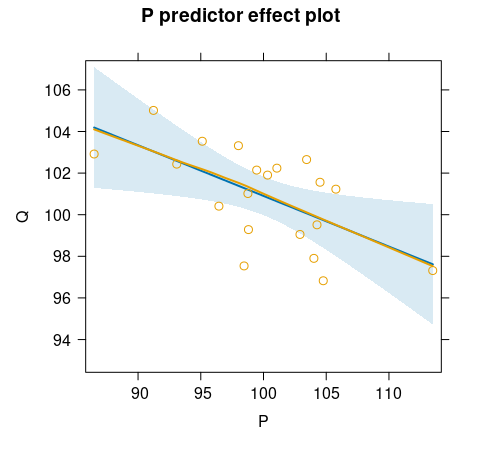
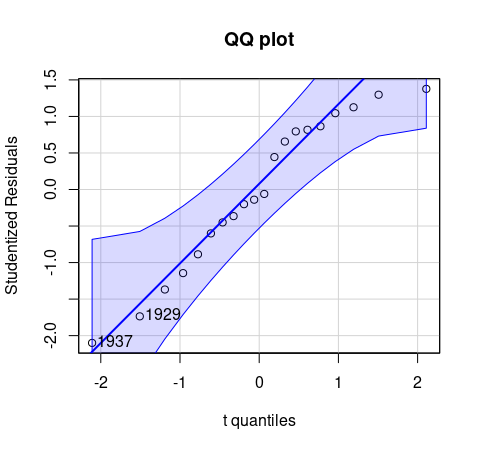
Figures reproduced from the package's official documentation — unofficial community showcase; all credit to the original authors.
The estimate
\tau_{\mathrm{LATE}}=\frac{\mathrm{Cov}(Y,Z)}{\mathrm{Cov}(D,Z)}=\frac{\mathbb E[Y\mid Z{=}1]-\mathbb E[Y\mid Z{=}0]}{\mathbb E[D\mid Z{=}1]-\mathbb E[D\mid Z{=}0]}
⚠️ Unofficial community showcase of ivreg (docs). Not affiliated with the authors — all credit to Guido Imbens & coauthors; this summarizes public documentation.
What it does. Estimates causal effects when treatment is endogenous, using an instrument that affects treatment but not the outcome directly. ivreg fits the model by two-stage least squares (2SLS) with a clean outcome ~ covariates | instruments formula and diagnostics (weak instruments, Wu-Hausman, Sargan). How it works. The first stage projects the endogenous regressor onto the instrument; the second stage regresses the outcome on these fitted values. Assumptions. Instrument relevance, exclusion, independence, and—for the causal interpretation—monotonicity (no defiers). Imbens's contribution. Imbens & Angrist (1994, Econometrica) showed that, under monotonicity, IV/2SLS identifies the Local Average Treatment Effect—the effect for compliers whose treatment responds to the instrument—reframing what 2SLS actually estimates with heterogeneous effects.
What you get — 2SLS coefficient (the LATE for compliers) with standard errors and IV diagnostic tests.
Example output
Call:
ivreg(formula = Q ~ P + D | D + F + A, data = Kmenta)

Coefficients:
            Estimate Std. Error t value Pr(>|t|)
(Intercept) 94.63330    7.92084  11.947 1.08e-09 ***
P           -0.24356    0.09648  -2.524   0.0218 *
D            0.31399    0.04694   6.689 3.81e-06 ***

Diagnostic tests:
                 df1 df2 statistic  p-value
Weak instruments   2  16    88.025 2.32e-09 ***
Wu-Hausman         1  16    11.422  0.00382 **
Sargan             1  NA     2.983  0.08414 .
---
Residual standard error: 1.966 on 17 degrees of freedom
Multiple R-Squared: 0.7548, Adjusted R-squared: 0.726
Discuss the workflow (0)
Log in to join the discussion.