
Matching for panel / time-series cross-sectional data (PanelMatch)

Follow the analysis.
Select a node to explore the method
Inspect treatment distribution
A pre-flight check — run this before trusting any estimate downstream.
Use DisplayTreatment() to visualize when democratization (dem) turns on across countries and years.
# Install:  install.packages("PanelMatch")
library(PanelMatch)
DisplayTreatment(unit.id = "wbcode2", time.id = "year",
                 treatment = "dem", data = dem,
                 legend.position = "none", xlab = "year", ylab = "Country Code")

Before using this step, make its assumptions and its output explicit. A useful peer note explains what you would check, what could go wrong, or what would change your interpretation.
Questions to explore- Which assumption matters most here, and what evidence could challenge it?
- What would you check before passing this output to the next step?
Choose a question to start your comment.
Peer discussion
- Bring your experience, a question, or a different perspective.
Log in to comment on this step.
Build matched sets
The core estimate — where the causal quantity itself is computed.
Run PanelMatch() with a 4-period lag and propensity-score weighting to match treated to control histories.
PM.results <- PanelMatch(lag = 4, time.id = "year", unit.id = "wbcode2",
                         treatment = "dem", refinement.method = "ps.weight",
                         data = dem, match.missing = FALSE, listwise.delete = TRUE,
                         covs.formula = ~ I(lag(tradewb, 1:4)) + I(lag(y, 1:4)),
                         size.match = 5, qoi = "att", outcome.var = "y",
                         lead = 0:4, forbid.treatment.reversal = FALSE)
Before using this step, make its assumptions and its output explicit. A useful peer note explains what you would check, what could go wrong, or what would change your interpretation.
Questions to explore- Which assumption matters most here, and what evidence could challenge it?
- What would you check before passing this output to the next step?
Choose a question to start your comment.
Peer discussion
- Bring your experience, a question, or a different perspective.
Log in to comment on this step.
Check covariate balance
A pre-flight check — run this before trusting any estimate downstream.
Use get_covariate_balance() to confirm the matched sets balance the lagged covariates.
get_covariate_balance(PM.results$att, data = dem,
                      covariates = c("tradewb", "y"), plot = FALSE)
Before using this step, make its assumptions and its output explicit. A useful peer note explains what you would check, what could go wrong, or what would change your interpretation.
Questions to explore- Which assumption matters most here, and what evidence could challenge it?
- What would you check before passing this output to the next step?
Choose a question to start your comment.
Peer discussion
- Bring your experience, a question, or a different perspective.
Log in to comment on this step.
Estimate the ATT (DiD)
The core estimate — where the causal quantity itself is computed.
PanelEstimate() applies a difference-in-differences estimator with bootstrap standard errors.
PE.results <- PanelEstimate(sets = PM.results, data = dem)
Before using this step, make its assumptions and its output explicit. A useful peer note explains what you would check, what could go wrong, or what would change your interpretation.
Questions to explore- Which assumption matters most here, and what evidence could challenge it?
- What would you check before passing this output to the next step?
Choose a question to start your comment.
Peer discussion
- Bring your experience, a question, or a different perspective.
Log in to comment on this step.
Summarize and plot leads
Reporting — turn the numbers into a figure or table a reader can act on.
summary() and plot() report the dynamic ATT for each lead period with confidence intervals.
summary(PE.results)
plot(PE.results)
Before using this step, make its assumptions and its output explicit. A useful peer note explains what you would check, what could go wrong, or what would change your interpretation.
Questions to explore- Which assumption matters most here, and what evidence could challenge it?
- What would you check before passing this output to the next step?
Choose a question to start your comment.
Peer discussion
- Bring your experience, a question, or a different perspective.
Log in to comment on this step.
Inputs & data
A long-format panel with unit ID, time ID, a binary treatment, an outcome, and time-varying covariates.
Show data format & exampleHide example
| unit | year | treat | outcome | gdp |
|---|---|---|---|---|
| A | 2001 | 0 | 12.4 | 3.1 |
| A | 2002 | 1 | 13.0 | 3.4 |
| B | 2001 | 0 | 9.8 | 2.2 |
| B | 2002 | 0 | 10.1 | 2.5 |
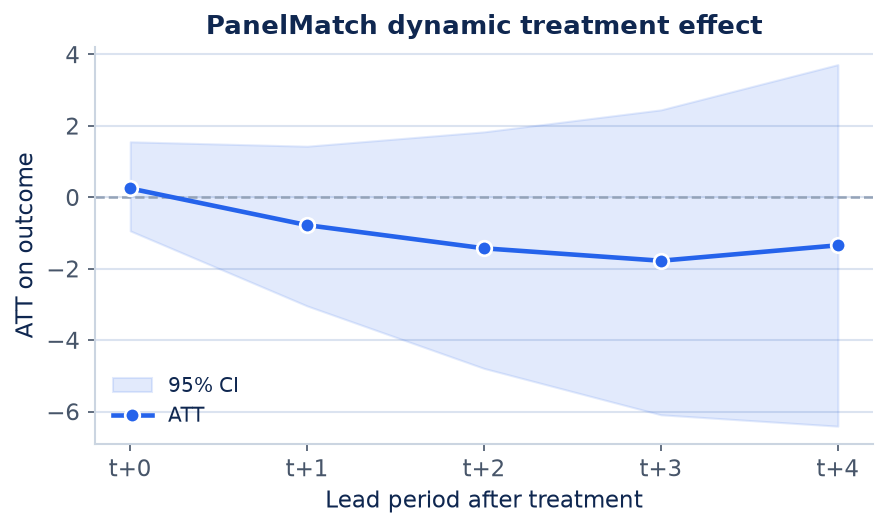
Result figure rendered by StatsOtter from the package's documented example — unofficial community showcase; all credit to the original authors.
The estimate
\hat\delta_F=\frac{1}{|\mathcal A|}\sum_{(i,t)\in\mathcal A}!\Big{(Y_{i,t+F}-Y_{i,t-1})-\sum_{j\in\mathcal M_{it}}w_{ij}(Y_{j,t+F}-Y_{j,t-1})\Big}
⚠️ Unofficial community showcase of PanelMatch (docs). Not affiliated with the authors — all credit to Kosuke Imai & coauthors; this summarizes public documentation.
What it does: PanelMatch implements the Imai-Kim-Wang matching framework for causal inference with time-series cross-sectional (panel) data and binary treatments. How it works: for each treated observation it builds a matched set of control units that share an identical treatment history over a user-specified number of lags. The matched set is then refined by Mahalanobis distance, propensity-score matching, or propensity-score weighting on time-varying covariates. Treatment effects are estimated with a difference-in-differences estimator that nets out unit and time effects, yielding short- and long-term ATTs with block-bootstrap standard errors. Assumptions: a parallel-trends/limited-carryover assumption conditional on treatment history and covariates, plus no unobserved time-varying confounding. The package also provides covariate-balance diagnostics and visualizations of treatment-variation and matched sets so users can assess match quality before estimation.
What you get — Short- and long-term ATTs (point estimates at multiple lead periods) with bootstrapped confidence intervals, plus covariate-balance and matched-set diagnostics.
Example output
Weighted Difference-in-Differences with Propensity Score
Matches created with 4 lags

Standard errors computed with 1000 Weighted bootstrap samples

Estimate of Average Treatment Effect on the Treated (ATT) by Period:
     estimate std.error      2.5%    97.5%
t+0    0.2475     0.633   -0.9410    1.554
t+1   -0.7800     1.144   -3.0426    1.430
t+2   -1.4290     1.700   -4.7917    1.832
t+3   -1.7770     2.187   -6.0908    2.448
t+4   -1.3450     2.567   -6.4096    3.715
Discuss the workflow (0)
Log in to join the discussion.