
Multiple imputation of missing data (Amelia)

Follow the analysis.
Select a node to explore the method
Load Amelia and the freetrade data
Data preparation — shapes the raw inputs into what the estimator expects.
Load the package and the freetrade panel of trade policy in Asian countries, which has missing values in tariff and other columns.
# Install:  install.packages("Amelia")
library(Amelia)
data(freetrade)
summary(freetrade)

Before using this step, make its assumptions and its output explicit. A useful peer note explains what you would check, what could go wrong, or what would change your interpretation.
Questions to explore- Which assumption matters most here, and what evidence could challenge it?
- What would you check before passing this output to the next step?
Choose a question to start your comment.
Peer discussion
- Bring your experience, a question, or a different perspective.
Log in to comment on this step.
Run multiple imputation with m = 5
The core estimate — where the causal quantity itself is computed.
Impute five completed datasets, declaring the panel/time structure with cs and ts.
a.out <- amelia(freetrade, m = 5, ts = "year", cs = "country")
Before using this step, make its assumptions and its output explicit. A useful peer note explains what you would check, what could go wrong, or what would change your interpretation.
Questions to explore- Which assumption matters most here, and what evidence could challenge it?
- What would you check before passing this output to the next step?
Choose a question to start your comment.
Peer discussion
- Bring your experience, a question, or a different perspective.
Log in to comment on this step.
Check imputation diagnostics
A pre-flight check — run this before trusting any estimate downstream.
Compare the observed and imputed densities and run an overimputation check to evaluate imputation quality.
compare.density(a.out, var = "tariff")
overimpute(a.out, var = "tariff")
Before using this step, make its assumptions and its output explicit. A useful peer note explains what you would check, what could go wrong, or what would change your interpretation.
Questions to explore- Which assumption matters most here, and what evidence could challenge it?
- What would you check before passing this output to the next step?
Choose a question to start your comment.
Peer discussion
- Bring your experience, a question, or a different perspective.
Log in to comment on this step.
Fit the model on each imputed dataset
The core estimate — where the causal quantity itself is computed.
Run the same regression on all five completed datasets and collect coefficients and standard errors.
b.out <- NULL; se.out <- NULL
for (i in 1:a.out$m) {
  ols <- lm(tariff ~ polity + pop + gdp.pc + year + country,
            data = a.out$imputations[[i]])
  b.out <- rbind(b.out, coef(ols))
  se.out <- rbind(se.out, coef(summary(ols))[, 2])
}
Before using this step, make its assumptions and its output explicit. A useful peer note explains what you would check, what could go wrong, or what would change your interpretation.
Questions to explore- Which assumption matters most here, and what evidence could challenge it?
- What would you check before passing this output to the next step?
Choose a question to start your comment.
Peer discussion
- Bring your experience, a question, or a different perspective.
Log in to comment on this step.
Combine estimates with Rubin's rules
Uncertainty quantification — standard errors, intervals, and aggregation.
Use mi.meld() to pool the per-imputation estimates into a single point estimate and standard error.
combined <- mi.meld(q = b.out, se = se.out)
combined$q.mi
combined$se.mi
Before using this step, make its assumptions and its output explicit. A useful peer note explains what you would check, what could go wrong, or what would change your interpretation.
Questions to explore- Which assumption matters most here, and what evidence could challenge it?
- What would you check before passing this output to the next step?
Choose a question to start your comment.
Peer discussion
- Bring your experience, a question, or a different perspective.
Log in to comment on this step.
Inputs & data
A data frame with missing values (NA), optionally with declared time-series/cross-section ID variables.
Show data format & exampleHide example
| year | country | gdp | trade |
|---|---|---|---|
| 1990 | A | 5.2 | NA |
| 1991 | A | NA | 41.0 |
| 1990 | B | 3.1 | 28.4 |
| 1991 | B | 3.4 | NA |
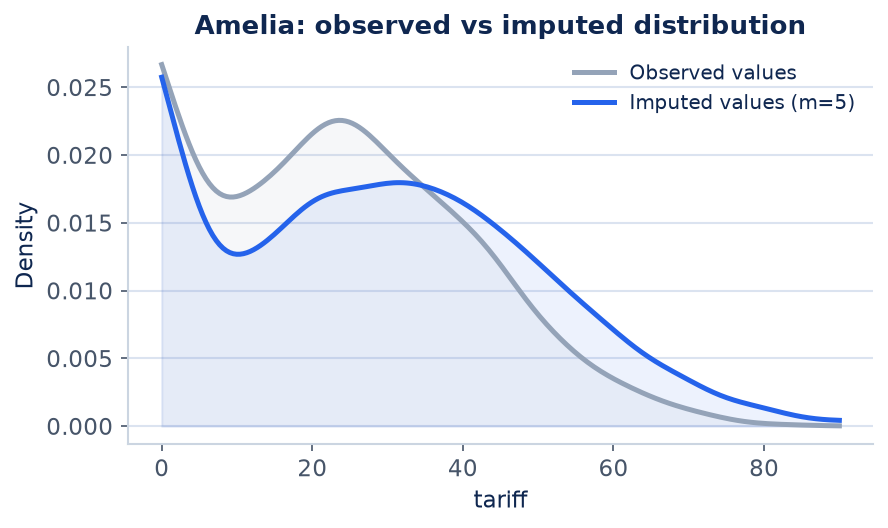
Result figure rendered by StatsOtter from the package's documented example — unofficial community showcase; all credit to the original authors.
The estimate
\bar Q=\frac1m\sum_{k=1}^{m}\hat Q_k,\qquad T=\bar U+\Big(1+\tfrac1m\Big)B
⚠️ Unofficial community showcase of Amelia (docs). Not affiliated with the authors — all credit to Gary King & coauthors; this summarizes public documentation.
What it does: Amelia (Amelia II) performs multiple imputation of missing data for cross-sectional, time-series, and time-series-cross-section datasets, generating m complete datasets that reflect imputation uncertainty. How it works: It assumes the data are jointly multivariate normal and missing at random, then uses an EMB (Expectation-Maximization with Bootstrapping) algorithm—bootstrapping the data and running EM on each replicate—which is far faster and more stable than MCMC approaches while giving comparable answers. It supports priors, transformations for skewed/bounded variables, and time and cross-section structure via polynomials of time and lags/leads. Assumptions: Multivariate normality (after transformation) and missing-at-random (MAR). Analysts fit their model on each imputed dataset and combine results with Rubin's rules. Output: m completed datasets plus diagnostics (overimputation, density comparisons) to assess imputation quality.
What you get — m completed datasets (imputations) plus diagnostics; analyze each and pool with Rubin's rules.
Example output
Amelia output with 5 imputed datasets.
Return code:  1
Message:  Normal EM convergence.

Chain Lengths:
--------------
Imputation 1:  17
Imputation 2:  20
Imputation 3:  16
Imputation 4:  18
Imputation 5:  19

Rows after Listwise Deletion:  96
Rows after Imputation:  171
Patterns of missingness in the data:  8

Fraction Missing for original variables:
-----------------------------------------

           Fraction Missing
tariff            0.34502924
polity            0.01169591
intresmi          0.07602339
signed            0.01754386
fiveop            0.10526316
Discuss the workflow (0)
Log in to join the discussion.