
Predicting race/ethnicity from name and geography (wru)

Follow the analysis.
Select a node to explore the method
Load wru and the voter file
Data preparation — shapes the raw inputs into what the estimator expects.
Load the package and the bundled example voter file containing surnames and geographic identifiers.
# Install:  install.packages("wru")
library(wru)
data(voters)

Before using this step, make its assumptions and its output explicit. A useful peer note explains what you would check, what could go wrong, or what would change your interpretation.
Questions to explore- Which assumption matters most here, and what evidence could challenge it?
- What would you check before passing this output to the next step?
Choose a question to start your comment.
Peer discussion
- Bring your experience, a question, or a different perspective.
Log in to comment on this step.
Predict race with BISG
The core estimate — where the causal quantity itself is computed.
Call predict_race() to combine the surname likelihood with Census tract-level racial composition (Bayesian Improved Surname Geocoding).
predict_race(voter.file = voters, census.geo = "tract",
             census.key = Sys.getenv("CENSUS_API_KEY"), party = "PID")
Before using this step, make its assumptions and its output explicit. A useful peer note explains what you would check, what could go wrong, or what would change your interpretation.
Questions to explore- Which assumption matters most here, and what evidence could challenge it?
- What would you check before passing this output to the next step?
Choose a question to start your comment.
Peer discussion
- Bring your experience, a question, or a different perspective.
Log in to comment on this step.
Inspect posterior probabilities
Reporting — turn the numbers into a figure or table a reader can act on.
The returned data.frame appends posterior race probabilities (pred.whi/bla/his/asi/oth) that sum to one per voter.
head(predict_race(voter.file = voters, surname.only = TRUE))
Before using this step, make its assumptions and its output explicit. A useful peer note explains what you would check, what could go wrong, or what would change your interpretation.
Questions to explore- Which assumption matters most here, and what evidence could challenge it?
- What would you check before passing this output to the next step?
Choose a question to start your comment.
Peer discussion
- Bring your experience, a question, or a different perspective.
Log in to comment on this step.
Inputs & data
A data frame of individuals with surname (and optionally first/middle name) plus geographic identifiers (state, county, tract, or block FIPS codes).
Show data format & exampleHide example
| surname | state | county | tract |
|---|---|---|---|
| Smith | NJ | 021 | 000100 |
| Garcia | CA | 037 | 207103 |
| Nguyen | TX | 201 | 412900 |
| Lee | NY | 061 | 010300 |
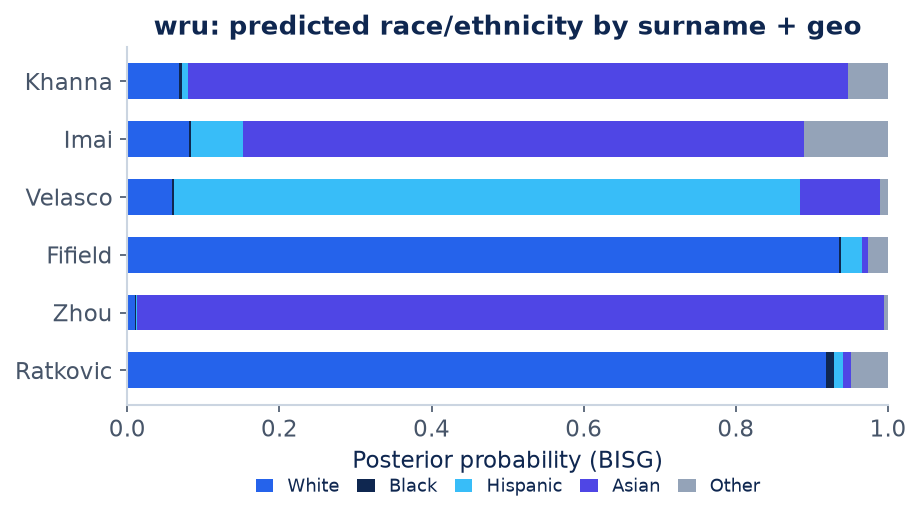
Result figure rendered by StatsOtter from the package's documented example — unofficial community showcase; all credit to the original authors.
The estimate
\Pr(R\mid S,G)=\frac{\Pr(S\mid R)\,\Pr(R\mid G)}{\sum_{r}\Pr(S\mid r)\,\Pr(r\mid G)}
⚠️ Unofficial community showcase of wru (docs). Not affiliated with the authors — all credit to Kosuke Imai & coauthors; this summarizes public documentation.
What it does: wru (Who Are You) produces probabilistic predictions of an individual's racial/ethnic category when race is unobserved—common in voter files, administrative records, and audits of disparities. How it works: it applies Bayesian Improved Surname Geocoding (BISG), combining Census surname (and optionally first/middle-name) race distributions with the racial composition of the person's geographic unit (state, county, tract, or block) via Bayes' Rule. Newer versions add fully Bayesian name-and-geography models and embedding-based features. The core call predict_race() returns, per person, posterior probabilities of being White, Black, Hispanic, Asian, or Other. Assumptions: accuracy depends on the conditional independence of surname and geography given race, on correct and current Census reference tables, and on representative geocoding; predictions are population-level probabilities, not certainties, and can be biased for groups or regions where the reference data fit poorly.
What you get — Per-individual posterior probabilities for each racial/ethnic category (pred.whi, pred.bla, pred.his, pred.asi, pred.oth).
Example output
  surname state county  tract age sex pred.whi pred.bla pred.his pred.asi pred.oth
   Khanna    NJ    021 004000  29   0   0.0676   0.0043   0.0082   0.8668   0.0531
     Imai    NJ    021 004501  40   0   0.0812   0.0024   0.0689   0.7375   0.1100
  Velasco    NY    061 004800  33   0   0.0594   0.0026   0.8227   0.1051   0.0102
  Fifield    NJ    021 004501  27   0   0.9356   0.0022   0.0285   0.0078   0.0259
     Zhou    NJ    021 004501  28   1   0.0098   0.0018   0.0007   0.9820   0.0058
 Ratkovic    NJ    021 004000  35   0   0.9187   0.0108   0.0108   0.0108   0.0488
Discuss the workflow (0)
Log in to join the discussion.