
Regression discontinuity, done right (rdrobust)

Follow the analysis.
Select a node to explore the method
Load senate data and inspect the running variable
Data preparation — shapes the raw inputs into what the estimator expects.
Load the Cattaneo-Frandsen-Titiunik U.S. Senate data and look at the Democratic margin of victory that determines incumbency.
# Install:  install.packages("rdrobust")   # R  ·  pip install rdrobust  (Python)
library(rdrobust)
data(rdrobust_RDsenate)
vote   <- rdrobust_RDsenate$vote     # Dem vote share next election (outcome)
margin <- rdrobust_RDsenate$margin   # Dem margin this election (running var)
summary(margin)

Before using this step, make its assumptions and its output explicit. A useful peer note explains what you would check, what could go wrong, or what would change your interpretation.
Questions to explore- Which assumption matters most here, and what evidence could challenge it?
- What would you check before passing this output to the next step?
Choose a question to start your comment.
Peer discussion
- Bring your experience, a question, or a different perspective.
Log in to comment on this step.
RD plot around the cutoff
A pre-flight check — run this before trusting any estimate downstream.
Bin the data and overlay local polynomial fits on each side of the c = 0 cutoff to visualize the discontinuity.
rdplot(y = vote, x = margin, c = 0,
       title = "RD Plot: U.S. Senate",
       x.label = "Dem. margin of victory",
       y.label = "Vote share, next election")
Before using this step, make its assumptions and its output explicit. A useful peer note explains what you would check, what could go wrong, or what would change your interpretation.
Questions to explore- Which assumption matters most here, and what evidence could challenge it?
- What would you check before passing this output to the next step?
Choose a question to start your comment.
Peer discussion
- Bring your experience, a question, or a different perspective.
Log in to comment on this step.
Data-driven optimal bandwidth
A pre-flight check — run this before trusting any estimate downstream.
Select the MSE-optimal bandwidth with rdbwselect before estimating the effect.
bw <- rdbwselect(y = vote, x = margin, c = 0, kernel = "triangular", bwselect = "mserd")
summary(bw)
Before using this step, make its assumptions and its output explicit. A useful peer note explains what you would check, what could go wrong, or what would change your interpretation.
Questions to explore- Which assumption matters most here, and what evidence could challenge it?
- What would you check before passing this output to the next step?
Choose a question to start your comment.
Peer discussion
- Bring your experience, a question, or a different perspective.
Log in to comment on this step.
Robust bias-corrected RD estimate
The core estimate — where the causal quantity itself is computed.
Estimate the local-linear treatment effect at the cutoff with robust bias correction; all=TRUE prints all three inference rows.
rd <- rdrobust(y = vote, x = margin, c = 0,
               kernel = "triangular", bwselect = "mserd", all = TRUE)
Before using this step, make its assumptions and its output explicit. A useful peer note explains what you would check, what could go wrong, or what would change your interpretation.
Questions to explore- Which assumption matters most here, and what evidence could challenge it?
- What would you check before passing this output to the next step?
Choose a question to start your comment.
Peer discussion
- Bring your experience, a question, or a different perspective.
Log in to comment on this step.
Read the three inference rows
Uncertainty quantification — standard errors, intervals, and aggregation.
summary() reports Conventional, Bias-Corrected, and Robust point estimates with their SEs and confidence intervals.
summary(rd)
Before using this step, make its assumptions and its output explicit. A useful peer note explains what you would check, what could go wrong, or what would change your interpretation.
Questions to explore- Which assumption matters most here, and what evidence could challenge it?
- What would you check before passing this output to the next step?
Choose a question to start your comment.
Peer discussion
- Bring your experience, a question, or a different perspective.
Log in to comment on this step.
Inputs & data
An outcome vector y and a running/forcing variable x (and a cutoff c, default 0).
Show data format & exampleHide example
| y (outcome) | x (running var) |
|---|---|
| 4.2 | -0.8 |
| 5.1 | -0.1 |
| 6.9 | 0.2 |
| 7.3 | 0.9 |
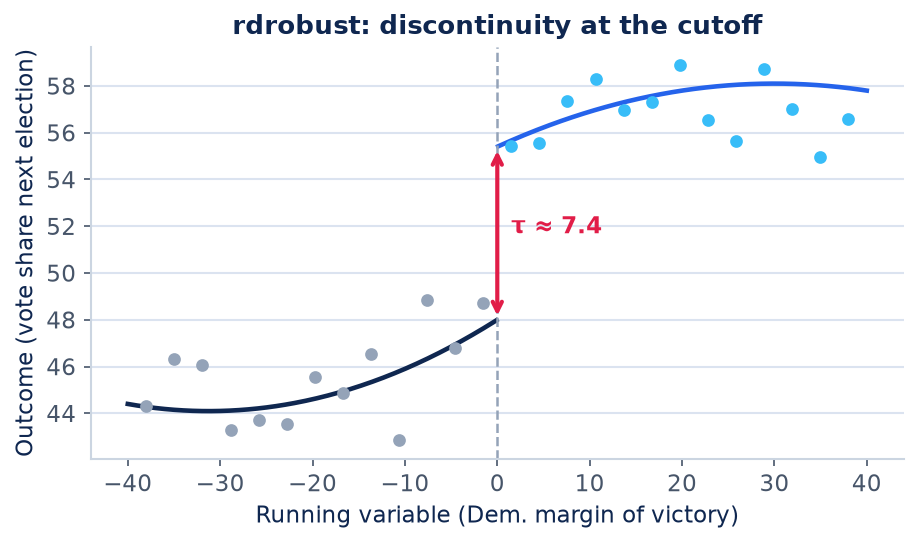
Result figure rendered by StatsOtter from the package's documented example — unofficial community showcase; all credit to the original authors.
The estimate
\tau_{\mathrm{RD}}=\lim_{x\downarrow c}\mathbb E[Y\mid X=x]-\lim_{x\uparrow c}\mathbb E[Y\mid X=x]
⚠️ Unofficial community showcase of rdrobust (docs). Not affiliated with the authors — all credit to Guido Imbens & coauthors; this summarizes public documentation.
What it does. In a regression discontinuity (RD) design, units just above and just below a cutoff on a running variable are treated as if randomized; rdrobust estimates the jump in the outcome at the cutoff. How it works. It fits local-linear (or local-quadratic) regressions on each side of the threshold, selects a data-driven bandwidth, and—critically—reports bias-corrected point estimates with robust confidence intervals that account for the bias introduced by the smoothing. Assumptions. Continuity of potential outcomes at the cutoff and no precise manipulation of the running variable; the estimate is a local effect at the threshold. Imbens's contribution. The mean-squared-error-optimal bandwidth selector originates with Imbens & Kalyanaraman (2012, Review of Economic Studies); rdrobust (Calonico, Cattaneo, Farrell, Titiunik) builds robust inference on top of that bandwidth lineage.
What you get — RD point estimate at the cutoff with conventional, bias-corrected, and robust standard errors / CIs.
Example output
Sharp RD estimates using local polynomial regression.

Number of Obs.                 1297
BW type                        mserd
Kernel                         Triangular
VCE method                     NN

Number of Obs.                  595          702
Eff. Number of Obs.             360          323
Order est. (p)                    1            1
BW est. (h)                  17.754       17.754

=============================================================================
        Method     Coef. Std. Err.    z     P>|z|      [ 95% C.I. ]
=============================================================================
  Conventional     7.414     1.459  5.083   0.000    [ 4.555 , 10.273 ]
Bias-Corrected     7.507     1.459  5.146   0.000    [ 4.647 , 10.366 ]
        Robust     7.507     1.741  4.311   0.000    [ 4.094 , 10.919 ]
=============================================================================
Discuss the workflow (0)
Log in to join the discussion.