
Sensitive questions, protected answers (rr)

Follow the analysis.
Select a node to explore the method
Load the survey data
Data preparation — shapes the raw inputs into what the estimator expects.
Use the Nigeria randomized-response survey, with the design probabilities for the forced-known design.
# Install:  install.packages("rr")
library(rr)
data(nigeria)
set.seed(1)

Before using this step, make its assumptions and its output explicit. A useful peer note explains what you would check, what could go wrong, or what would change your interpretation.
Questions to explore- Which assumption matters most here, and what evidence could challenge it?
- What would you check before passing this output to the next step?
Choose a question to start your comment.
Peer discussion
- Bring your experience, a question, or a different perspective.
Log in to comment on this step.
Fit the randomized-response regression
The core estimate — where the causal quantity itself is computed.
rrreg deconvolves the known randomization noise and fits a logistic model for the latent sensitive trait.
out <- rrreg(rr.q1 ~ cov.asset.index + cov.married + age,
             data = nigeria, p = 2/3, p1 = 1/6, p0 = 1/6,
             design = "forced-known")
summary(out)
Before using this step, make its assumptions and its output explicit. A useful peer note explains what you would check, what could go wrong, or what would change your interpretation.
Questions to explore- Which assumption matters most here, and what evidence could challenge it?
- What would you check before passing this output to the next step?
Choose a question to start your comment.
Peer discussion
- Bring your experience, a question, or a different perspective.
Log in to comment on this step.
Inputs & data
Survey data with the randomized-response item and predictor covariates.
Show data format & exampleHide example
| rr.q1 | asset.index | married | age |
|---|---|---|---|
| 1 | 0.4 | 1 | 41 |
| 0 | -1.1 | 0 | 33 |
| 1 | 0.9 | 1 | 52 |
| 0 | 0.2 | 0 | 29 |
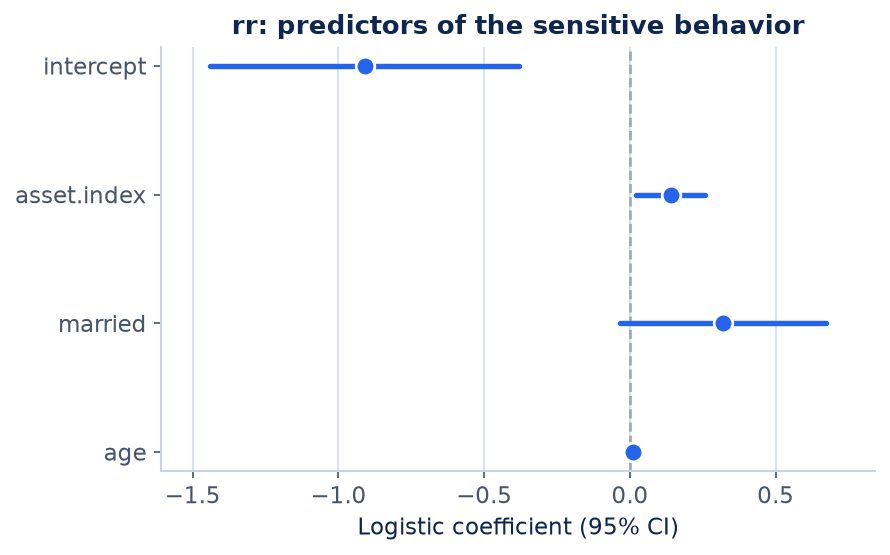
Result figure rendered by StatsOtter from the package's documented example — unofficial community showcase; all credit to the original authors.
The estimate
\Pr(Z_i^=1\mid x_i)=\mathrm{logit}^{-1}(x_i^\top\beta),\quad Y_i=\text{noisy RR of }Z_i^
⚠️ Unofficial community showcase of rr (docs). Not affiliated with the authors — all credit to Graeme Blair, Yang-Yang Zhou & Kosuke Imai; this summarizes public documentation.
What it does. The randomized-response technique lets people answer a sensitive yes/no question truthfully without revealing their answer, because a coin (known probability) sometimes dictates the response. rr (Blair, Imai & Zhou 2015) provides the multivariate regression that recovers how covariates predict the latent truthful response.
How it works. Given the design probabilities (mirrored, forced-known, or unrelated-question), rrreg() fits a maximum-likelihood logistic model for the latent sensitive trait, deconvolving the randomization noise. Companion functions predict prevalence and combine RR with direct questions.
Assumptions. Respondents follow the randomization device and answer truthfully under its protection; the design probabilities are known.
What you get — Logistic-regression coefficients (with SEs) linking covariates to the latent sensitive response, despite the privacy noise.
Example output
Randomized Response Technique Regression

Estimated coefficients (logistic):
                     est     se      z    p
(Intercept)        -0.91  0.27  -3.37  0.00
cov.asset.index     0.14  0.06   2.33  0.02
cov.married         0.32  0.18   1.78  0.08
age                 0.01  0.01   1.02  0.31

Design: forced-known   N = 2400
Discuss the workflow (0)
Log in to join the discussion.